





:max_bytes(150000):strip_icc()/GettyImages-928550046-60a39e36ac004bfb86d894b26d6f2a0b.jpg)





















Indonesia Coffee Shops Are Booming, but Farmers’ Productivity and Welfare Still Lag Behind
While Indonesia’s coffee industry is expanding rapidly and coffee shops are flourishing, many farmers still face challenges related to productivity, land conditions, and market access.

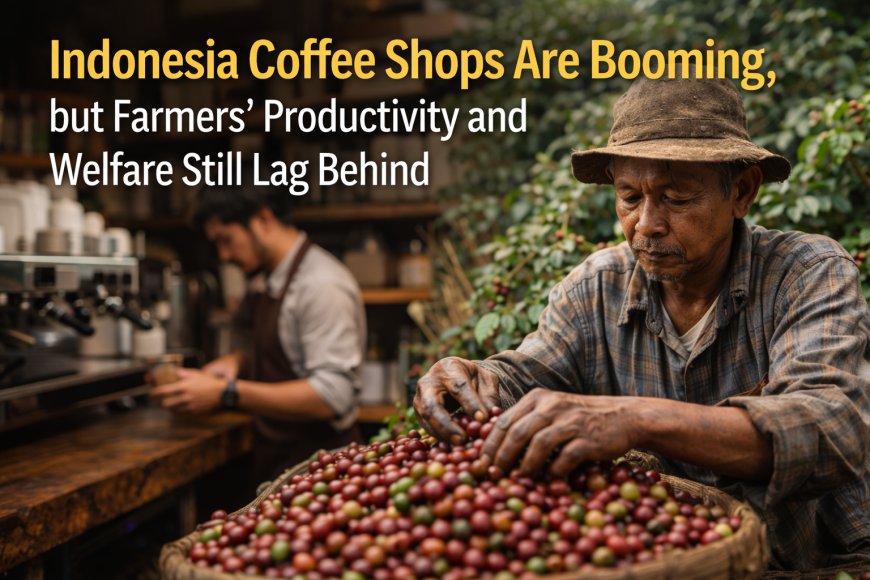
Coffee Shops Are Booming, but Farmers’ Productivity and Welfare Still Lag Behind
Indonesia is widely recognized as one of the largest coffee-producing countries in the world. According to data from the Ministry of Agriculture of the Republic of Indonesia, the country produced an average of 782,300 tons of coffee annually between 2021 and 2025, with most provinces experiencing steady growth in production.
Meanwhile, a report from Badan Pusat Statistik (BPS) shows that Indonesia’s coffee exports reached US$1.87 billion in 2025, an increase of 81.08 percent compared with 2024.
Several countries have consistently been major export destinations for Indonesian coffee since 2024, including:
-
the United States, accounting for 18.77 percent of total exports
-
Egypt with 8.70 percent
-
Malaysia with 7.96 percent
-
Belgium with 7.06 percent
National Coffee Day and the Welfare Gap
Every year on March 11, Indonesia celebrates National Coffee Day. The event aims to appreciate local coffee farmers, promote the diversity of Indonesian coffee, and support the development of the national coffee industry.
Despite Indonesia’s status as one of the world’s leading coffee producers, the welfare of coffee farmers has not improved significantly. This situation is largely caused by low plantation productivity and the practice of selling harvests to middlemen, often with inconsistent bean quality.
Plantation Productivity Challenges
Supriyadi, Professor of Food Technology and Agricultural Product Technology at the Faculty of Agricultural Technology at Universitas Gadjah Mada (UGM), explained that only about 75 percent of coffee plantation areas in Indonesia have the potential to improve productivity.
The remaining plantations are either unproductive or experiencing damage.
“About 10 percent of Indonesia’s coffee plantation land is still damaged. In addition to quantity issues, the quality of coffee beans is also often inconsistent,” Supriyadi said during a discussion at the UGM campus on Thursday (March 12).
According to him, productivity challenges also arise because many farmers prioritize faster harvesting processes, which can negatively affect bean quality.
“That is where the main challenge lies,” Supriyadi explained.
Collaboration and Fermentation to Improve Quality
To address these challenges, Supriyadi emphasized that coffee farmers should collaborate with coffee entrepreneurs and plantation industries.
One key step to maintain coffee quality is implementing proper fermentation processes during post-harvest handling. This requires consistent training and mentoring programs for farmers.
He also stressed the importance of innovation in coffee processing.
“For coffee that originally scores below 80 in quality assessments, additional processing innovations can raise the score to 82–84 or higher,” he explained.
Innovation Through Coffee Blending
One innovation that can enhance the quality and uniqueness of Indonesian coffee is blending, a method that mixes two or more types of coffee to create distinctive flavors.
Supriyadi mentioned an interesting innovation he encountered known as Kopi Tahlil, a unique coffee from Pekalongan.
This coffee blend combines coffee with eleven different spices, creating a distinctive and aromatic beverage.
“Innovation like this offers new ways for people to enjoy coffee with unique flavor profiles,” he said.
Rapid Growth of Coffee Culture
Over the past decade, Indonesia’s coffee industry has expanded significantly, both in plantation development and consumption levels.
The growing trend of coffee drinking in major cities has also led to the rapid emergence of coffee shops across the country.
“Within the next one to two years, the number of coffee shops in Indonesia could exceed 11,000 outlets. This represents enormous potential for the coffee industry,” Supriyadi added.
Looking Ahead
Supriyadi hopes that in the future, coffee farmers in Indonesia will experience better economic welfare, while Indonesian coffee continues to be enjoyed by people from all walks of life.
He also encouraged Indonesian coffee producers to keep innovating and promoting local coffee varieties to strengthen the country’s position in the global coffee market.
What's Your Reaction?